| All-Sky Automated Survey for Supernovae | |
|
 Channel |
ASAS (Warsaw) Channel |
ASAS (Warsaw)
ASAS-SN is currently comprised of two units. ASAS-SN Unit-1, known as "Brutus", which also happens to be the name of the Ohio State mascot, is comprised of four robotic 14-cm telescopes deployed at the Haleakala station of the Las Cumbres Observatory Global Telescope Network. ASAS-SN Unit-2, named "Cassius", also consists of four 14-cm telescopes deployed at the LCOGT Cerro Tololo station. Together, these allow us to observe a total of approximately 20,000 square degrees each clear night. Eventually we would like to deploy a total of 16 telescopes at four different sites, allowing us to survey the entire visible sky every night. We started real-time reduction and analysis of "Brutus" four-telescope data in December 2013 and are continuing to make interesting discoveries. In addition, the "Cassius" system is also making many discoveries, and in July 2015 it was expanded to four telescopes.
We are discovering numerous
bright supernovae in both hemispheres (299 total, 179 in
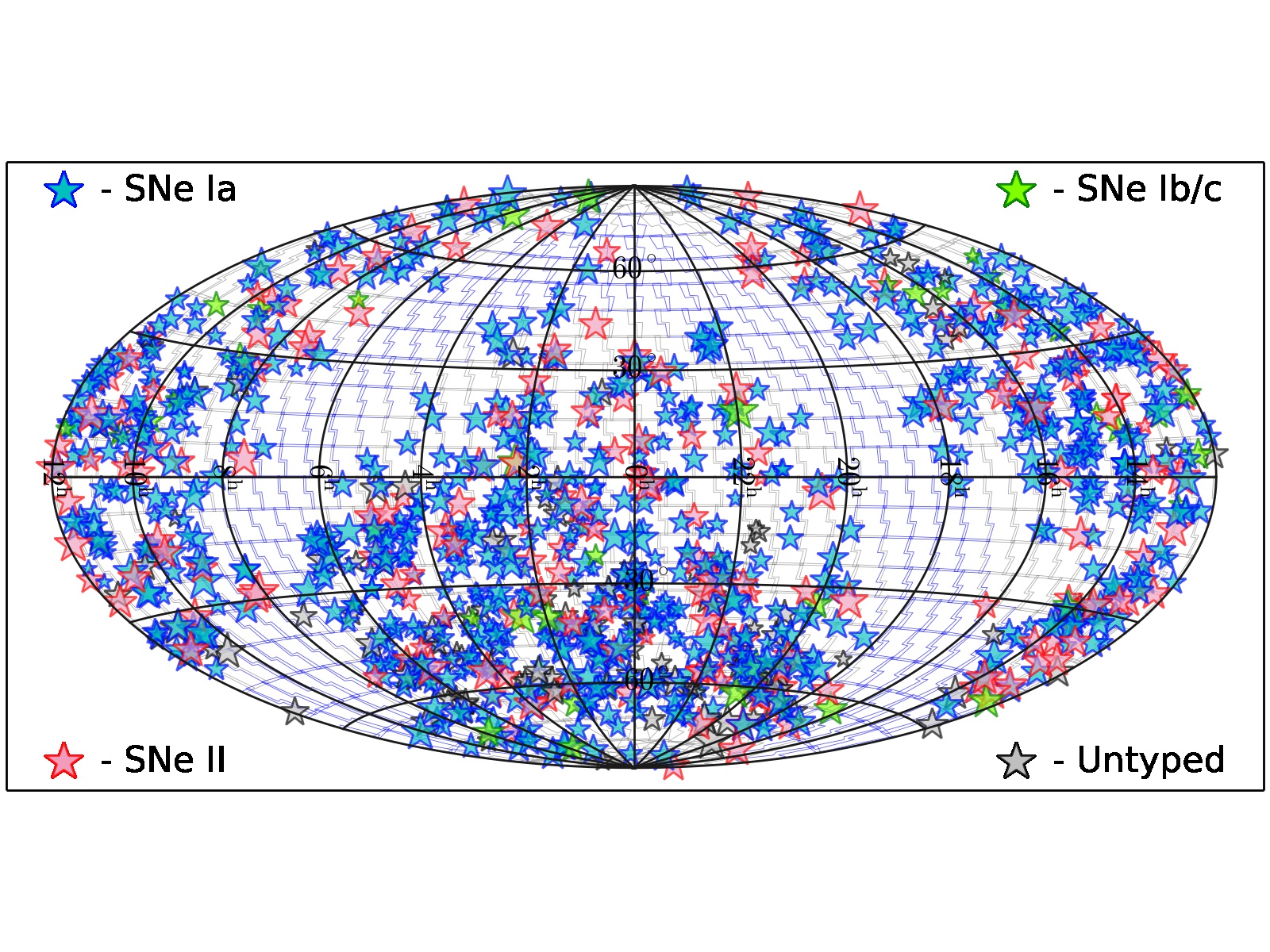
2015). See below where our supernova
discoveries announced so far are located on the sky (bigger
symbols - smaller distance)
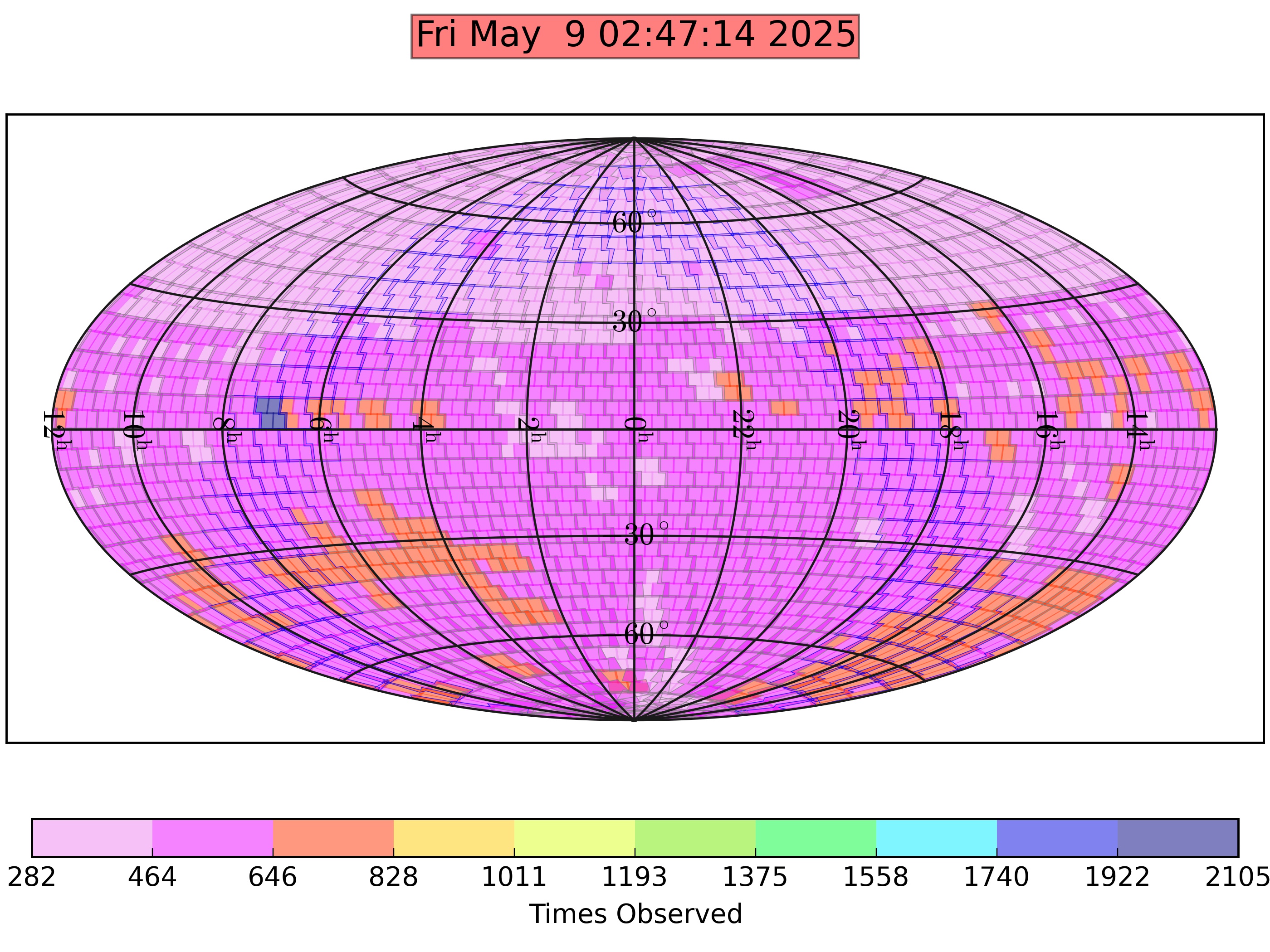
Here are some of our most exciting objects: ASASSN-15ts (December 2015). Type Ia supernova, V=17.3, about 250 Mpc away. Our 250th supernova! ASASSN-15nr (August 2015). Type Ia supernova, V=16.8, about 100 Mpc away. Our 200th supernova! ASASSN-15il (May 2015). Type Ia supernova, V=16.7, about 100 Mpc away. Our 150th supernova! ASASSN-15az (January 2015). Type Ia supernova, V=16.7, about 125 Mpc away. Our 100th supernova! ASASSN-14lp (December 2014). SN Type Ia. V=13.0, about 18 Mpc away. Our brightest supernova so far! ASASSN-14li (December 2014). A Tidal Disruption Event (TDE) in PGC 043234 (z=0.0206). About 90 Mpc away, this is the closest TDE ever discovered in optical wavelengths. ASASSN-14kq (November 2014). SN Type Ia. V=16.8, about 140 Mpc away. Our 75th supernova! ASASSN-14fj (August 2014). SN Type II in NGC 5732. V=16.8, about 53.9 Mpc away. Our 50th supernova! ASASSN-14dc (June 2014). SN in 2MASX J02183825+3336556. V=15.8, our furthest away and most luminous supernova so far (about 200 Mpc away, M_V=-20.6). ASASSN-14cu (June 2014). SN Type Ia in 2MASX_J12470274-2414435. V=16.2, about 108 Mpc away. The first supernova discovered with our Cassius unit! ASASSN-14cl (June 2014). A very large amplitude CV outburst that has been observed more than 20,000 times! ASASSN-14ax (May 2014). SN Type Ia in SDSS J171000.70+270619.6. V=16.5, about 140 Mpc away. Our 20th supernova! ASASSN-14ae (January 2014). A Tidal Disruption Event (TDE) in SDSS J110840.11+340552.2 (z=0.04367). About 200 Mpc away, at the time the closest TDE discovered in optical. ASASSN-13dm (December 2013). SN Type Ia in PGC 2816341. V=15.9, about 70 Mpc away. The first ASAS-SN supernova found using four-telescope configuration. We started real-time reduction and analysis of "Brutus" two-telescope data in April 2013 and we had a number of exciting discoveries: ASASSN-13cp (August 2013). SN Type Ia. Our 10th supernova! ASASSN-13co (August 2013). SN Type IIP. Our first non-Ia supernova, about 90 Mpc away! ASASSN-13ck (August 2013). Large amplitude outburst (8 magnitudes) cataclysmic variable. ASASSN-13cb (August 2013). Extreme (delta V~9 mag) M-dwarf Flare. ASASSN-13an (June 2013). SN Type Ia. Our first supernova! AGN Outburst and Dramatic Seyfert Type Change in NGC 2617 (April/May 2013). See also ATel #5103, #5059 and #5039. Generally we are posting our real-time discoveries using ATel, so if you interested in being notified of our results, you should subscribe to that useful service, and also see our ASAS-SN Transients page. See our sky coverage plot for the last 365 days (we will start observing the missing bits in 2016):
At this point we are focused on discovering bright, nearby supernovae, but we like all kinds of variable objects, so if there is an object with V-band magnitude between V~9 and V~17 that we might have in our data, send us an e-mail and we will check what we have.
ASAS-SN Team: At OSU: Jon Brown, Diego Godoy, Tom Holoien, Chris Kochanek, Kris Stanek, Greg Simonian, Udit Basu (high school student), John Beacom, Todd Thompson; Ben Shappee has moved (August 2014) to Carnegie Observatories, Pasadena, to start his 5-year Hubble-Carnegie-Princeton Postdoctoral Fellowship; José Luis Prieto (Universidad Diego Portales; MAS); Grzegorz Pojmanski (Warsaw University Observatory); Joseph Brimacombe (Coral Towers Observatory); David Bersier (LJMU); Subo Dong, Ping Chen (KIAA-PKU); Emilio Falco (CfA); Przemek Wozniak (LANL); Maximilian Stritzinger (Aarhus); Laura Chomiuk, Jay Strader (MSU); Raffaella Margutti (NYU). We thank LCOGT and its staff for their continued support of ASAS-SN: we truly could not do this without your help. An important part of our project is the follow-up effort with bigger telescopes to get confirmation imaging (our images have 7.8" pixels). We are fortunate to have a number of "unpaid professional astronomers" working with us on ASAS-SN "ad hoc" SN confirmation effort: E. Conseil (Association Francaise des Observateurs d'Etoiles Variables, France), I. Cruz (Cruz Observatory, USA), J. M. Fernandez (Observatory Inmaculada del Molino, Spain), S. Kiyota (Variable Star Observers League in Japan), R. A. Koff (AntelopeHills Observatory), G. Krannich (Roof Observatory Kaufering, Germany), G. Masi (Virtual Telescope Project, Ceccano, Italy), L. A. G. Monard (Klein Karoo Observatory, Western Cape, South Africa), B. Nicholls (Mt. Vernon Obs., New Zealand), J. Nicolas (Groupe SNAUDE, France) and W. Wiethoff (University of Minnesota, Duluth, USA). You can see from many joint Astronomer's Telegrams we have published that it is a very fruitful collaboration! A number of professional astronomers have also contributed their effort and telescope time to ASAS-SN, which we most appreciate! Here are the names of our collaborators on ASAS-SN results annouced so far: S. Adams (Ohio State), E. Alper (Dartmouth), A. Campillay (Las Campanas Observatory), C. Choi (Seoul National University), C. Contreras (Las Campanas Observatory), C. Copperwheat (LJMU), G. De Rosa (Ohio State), M. Dietrich (Ohio University), S. Dong (KIAA), M. Fausnaugh (Ohio State), J. Fernandez (Pontificia Universidad Catolica), D. Grupe (Penn State), D. Gifford (University of Michigan), M. Giustini (XMM-Newton Science Operation Centre), C. Gonzalez (Las Campanas Observatory), A. Goulding (CfA), Z. Guo (KIAA), K. Hainline (Dartmouth), D. Hartmann (Clemson), G. Herczeg (KIAA), R. Hickox (Dartmouth), R. Hounsell (STScI), D. Howell (LCOGT), E. Hsiao (Las Campanas Observatory), M. Im (Seoul National University), J. Jose (KIAA), A. Kaur (Clemson), S. Komossa (Max-Planck Institut fur Radioastronomie), M. Koss (IfA), P. Lira (U. Chile), K. Leighly (University of Oklahoma), S. Mathur (Ohio Sate), N. Morrell (LCO), A. Mosquera (Ohio State), D. Mudd (Ohio State), J. Nugent (University of Oklahoma), B. Peterson (Ohio State), M. Phillips (Carnegie Observatories), R. Pogge (Ohio State), A. Porter (Clemson), J. Rich (Carnegie Observatories), D. Sand (Texas Tech University), S. Schmidt (Ohio State), A. Sheffield (Columbia), S. Starrfield (ASU), J. Thorstensen (Dartmouth), M. Wagner (LBTO), A. Wilber (ASU), C. Woodward (U. Minnesota), S. Valenti (LCOGT), S. Villanueva (Ohio State), Y. Yoon (Seoul National University), Y. Zu (Carnegie Mellon) (if we missed your name, please let us know).
So when you get an e-mail or a phone-call from us, asking to
collaborate on a new exciting ASAS-SN target, we hope you will say
"yes"!
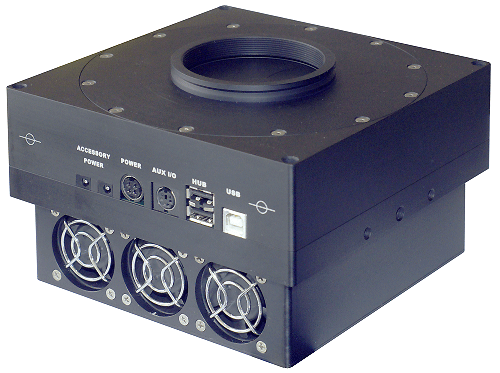
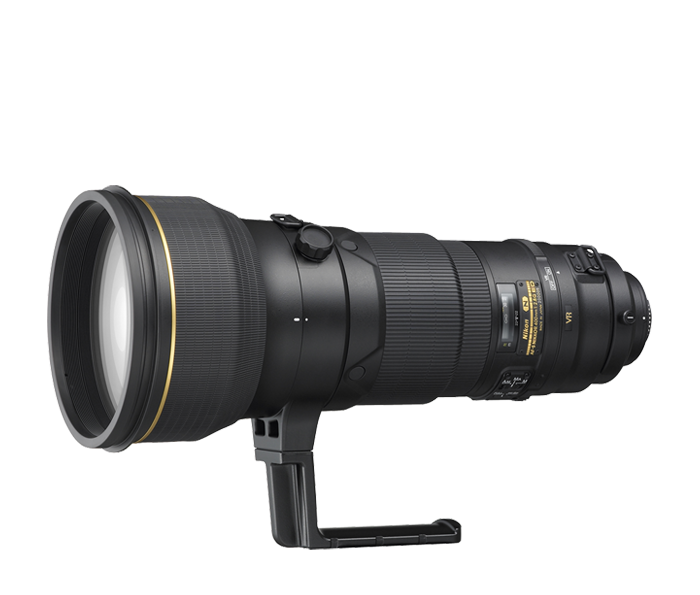
Our team makes ASAS-SN a success, but we also need excellent hardware to aid us in our ultimate goal of studying real-time variability of the entire sky:
|