Astronomy 292
Week 8: Active Galaxies
Monday, February 23: Superclusters and Voids
The structure of the universe is hierarchical; there is
structure on a wide range of length scales.
- Stars are found mainly in
gravitationally bound galaxies.
- Galaxies are found mainly in
gravitationally bound clusters.
- Clusters are found mainly in
superclusters, which are currently collapsing.
For superclusters to be collapsing today, they must have a
freefall time comparable to the Hubble time, H0-1.
This implies that their density must be
rho ~ 3 pi H02/(32 G)
~ 2x10-26kg/m3 ~ 3x10¹¹
Msun/Mpc3.
Superclusters are most easily seen in three-dimensional
maps made using the redshifts of galaxies to estimate
their distance: d = (c/H0)z. A ``wedge diagram''
shows the distribution of galaxies in space:
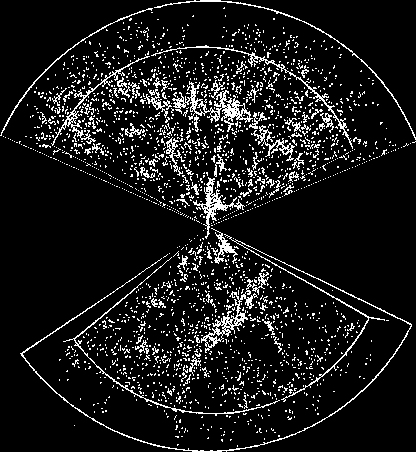
The two wedges shown above contain 9500 galaxies out to a redshift
of z=0.05 (corresponding to a distance of 215 Mpc). The
largest structures seen in redshift surveys are superclusters
about 100 Mpc long. The Local Group and the Virgo Cluster are
both contained within the Local Supercluster.
Properties of superclusters:
- Elongated filaments or walls, not spheres.
- Maximum size ~ 100 Mpc (Larger objects have not yet had time
to collapse, so there are no ``superduperclusters''.)
Properties of voids (low-density regions between superclusters):
- Roughly spherical in shape, making the universe look
``bubbly'' or ``frothy'' on large scales.
- Maximum size ~ 100 Mpc.
- Free of bright galaxies; dark matter content not well known.
Redshift surveys should be used with the caveat that not all
redshifts are due to the expansion of the universe. For instance,
rich clusters in wedge diagrams show the ``finger of God'' effect;
they tend to be elongated in the radial direction. This elongation
received its curious name because the grossly stretched-out cluster
is jokingly compared to the finger of God pointing accusingly at
the observer, while God thunders, `You are WRONG!'. What you've
done wrong, in this case, is assume that the redshift z measured for
each cluster galaxy can be converted to a distance d = (c/H0)z.
In fact, if a cluster at a distance d has a velocity dispersion
sigma along the line of sight, some galaxies will have a radial
speed of +sigma with respect to the center of mass of the
cluster, while others will have a radial speed of -sigma.
Thus, two galaxies quite close to each other in the cluster
can have redshifts that differ by
Delta z ~ 2 sigma / c.
If we naively convert observed redshifts to distances, we will
conclude that the finger of God has a length
Delta d ~ (c/H0) Delta z ~ 2 sigma / H0.
Thus, the Coma cluster, which has sigma ~ 900 km/s, appears
to be stretched to a length of Delta d ~ 30 Mpc in a wedge
diagram, when its actual diameter is only 3 Mpc.
Since the largest structures in the universe are 100 Mpc
superclusters, the region within a few hundred Mpc of
the Galaxy is expected to be a fair sample of the
universe at the present day. Within this region, the
galaxy luminosity function is found to have a power-law
form with an exponential cutoff:
Phi(L) dL = Phi* (L/L*)a
exp (-L/L*) dL/L*,
where Phi is the number of galaxies per cubic Mpc per
unit interval in luminosity. The exponential cutoff
kicks in at a luminosity
L* ~ 2x10¹⁰Lsun ~ LMW.
At luminosities below the cutoff, the luminosity function
is a power law of index
a ~ -1.2.
The overall normalization of the luminosity function is
Phi* ~ 0.01 Mpc-3.
The form of the luminosity function is poorly known for
L < 0.1 L*; determining the number of dwarf galaxies
in the universe is extremely difficult. The total
luminosity density of the universe, found by integrating
Phi(L) times L from L=0 to L=infinity, is
rhoL ~ 2x10⁸ Lsun/Mpc3.
This is equivalent to a single 40-watt light bulb within
a sphere 1 A.U. in radius. By terrestrial standards, the universe
is a shockingly poorly lit place.
Tuesday, February 24: Active Galactic Nuclei
How do you tell an active galaxy from
a normal galaxy? Here are some of the attributes of
active galaxies:
- The galaxy has high luminosity: L > 1037 watts
(L > 3x10¹⁰ Lsun)
- Much of the emission is nonthermal, as
compared to the thermal emission from stars and warm dust.
- Much of the emission is from the central nucleus.
- The luminosity of the nucleus is variable
on short time scales (t < 1 month).
- Jets lead away from the nucleus.
- The spectrum of the nucleus shows emission lines.
Not every active galaxy possesses every one of these attributes.
There are different classes of active galaxies, classified
according to the properties they display.
(Galaxies with highly luminous nuclei are generically
called AGNs -- short for Active Galactic Nucleus).
One class of active galaxies is Seyfert Galaxies.
Seyfert galaxies are spiral galaxies which have very luminous,
variable nuclei with emission-line spectra. Type 1
Seyferts have broad Balmer emission lines (v > 5000 km/s).
Type 2 Seyferts have narrower Balmer
emission lines (v < 400 km/s).
Another class of active galaxies is BL Lac objects.
BL Lacertae, the prototype of this class, was initially mistaken
for a variable star. This is because BL Lac objects have extraordinarily
luminous nuclei which vary on time scales of 1 day. It is probable
that BL Lac objects are elliptical galaxies, but it's hard to determine
their morphology because their nuclei are so bright. BL Lac objects
have a nonthermal continuum spectrum, with no emission lines.
Yet another class of active galaxies is radio galaxies.
The brightest objects in the sky at radio wavelengths are all radio
galaxies. A galaxy is classified as a radio galaxy if it has
Lradio > 1033 watts, but that's a fairly
arbitrary dividing line. Strong radio sources are usually associated
with elliptical galaxies, but some radio galaxies (like Centaurus A)
are just plain peculiar in morphology. Extended
radio galaxies have large jets, which can be much larger than
the galaxy as seen at visible wavelengths. Cygnus A, for instance,
has radio jets roughly half a megaparsec long. Compact
radio galaxies have short jets and a nuclear radio source.
The giant elliptical galaxy M87, in the Virgo Cluster, goes
under the alias ``Virgo A''; it is the brightest radio source
in the constellation Virgo. M87 has a jet 2 kpc long. Its central
nucleus is surrounded by a gas disk of radius r = 16 pc =
4.9x10¹⁷m. The inclination of the disk is roughly
i = 42 degrees. The disk is rotating, with a circular speed of
vc = 460 km/s / sin i = 690 km/s. The mass inside
the disk is thus
M = vc2 r / G = (6.9x10⁵)2
4.9x10¹⁷ / 6.67x10-11 = 4x1039kg =
2x10⁹Msun.
The compact mass at the center of M87 is, in all likelihood, a
supermassive black hole, 800 times more massive than the black
hole at the center of our galaxy.
The Unified Model of AGNs states that every
AGN has a supermassive black hole at its center. The black hole
is surrounded by a thick accretion disk of gas and dust. Jets of
matter are ejected along magnetic field line in two directions,
perpendicular to the disk.
- If we view the AGN straight along a jet, we see a BL Lac
object; the spectrum is dominated by the synchrotron emission
from the hot, magnetized jet.
- If we view the AGN at a slight angle to the jet, we
see a Type 1 (broad emission line) Seyfert. At this angle,
we can see all the way to the Broad Line Region close to
the black hole, where speeds are rapid and the resulting
Doppler broadening of emission lines is large.
- If we view the AGN at a larger angle to the jet, we
see a Type 2 (narrow emission line) Seyfert. At this angle,
the thick dusty disk blocks our view of the Broad Line Region,
so we see only material with slower speeds and less Doppler
broadening of the emission lines.
How much matter must be fed into a black hole to maintain
the AGN's luminosity. If a bit of matter (mass = m) is
lowered toward a black hole of mass M, then if the matter
starts at a radius much greater than the Schwarzschild radius,
the amount of gravitational potential energy it has lost by the time it
reaches the Schwarzschild radius is
Delta E = G M m / Rs = G M m / ( 2 G M / c2 ) =
0.5 m c2.
In the real universe, not all the gravitational potential
energy is converted into photons (some goes into the kinetic
energy of the jet, for instance). It is customary to write the
photon energy produced as
Delta Ephot = eta m c2,
where eta is a dimensionless number less than 1/2, known as
the ``efficiency''. For a typical AGN, it is thought that
eta ~ 0.1. (Feed a gram of stuff into a black hole, and get
9 trillion joules of energy in return, in the form of photons.)
Wednesday, February 25: Quasars
The luminosity of an accreting black hole is:
L = eta (dm/dt) c2,
where dm/dt is the infall rate. If we know an AGN's luminosity,
we can deduce its infall rate:
dm/dt = L / (eta c2) = 0.02 Msun/yr
(L / 1037W) (eta/0.1)-1.
The inflow rate will probably not be steady; the luminosity
of an accreting black hole will leap upward, for instance,
if a star is tidally shredded and swallowed by the black hole.
What is the maximum possible luminosity of an accreting black
hole? The maximum luminosity is imposed by the fact that
outflowing photons exert a force on the inflowing gas.
Consider an accreting black hole with mass M and luminosity L;
it is surrounded by ionized hydrogen. At a distance r from
the black hole, the outgoing photons carry
an energy flux
f = L / (4 pi r2).
Since an individual photon of energy E has a momentum p = E/c,
the outgoing photons also carry a momentum flux
fp = L / (c 4 pi r2) .
Because the photons carry momentum, they exert force on the
electrons and protons. The force exerted on each particle (that
is, the rate at which momentum is transferred to it) depends
on its cross-section for interactions with photons. The
cross-section for an electron is the Thomson cross-section:
sigmaT = 6.65x10⁻²⁹m2.
(The cross-section for protons is smaller by a factor of
1/3,000,000.)
An electron will feel an outward force due
to interactions with photons. The amplitude of this radiation
force is
Frad = fp sigmaT = (L sigmaT) /
(c 4 pi r2).
As the electron is accelerated, it drags the nearest proton
along with it, preserving charge neutrality.
An electron-proton pair will feel an inward force
due to gravity. The amplitude of this gravitational force is
Fg = - (G M [mp+me])/r2
~ - (G M mp)/r2.
The maximum possible luminosity for the accreting black hole
is called the Eddington luminosity. It's the
luminosity for which the inward and outward forces balance:
(LE sigmaT)/(c 4 pi r2) =
(G M mp)/r2,
or
LE = (4 pi G mp c M)/ sigmaT =
1.3x1031 watts (M/Msun) =
33,000 Lsun (M/Msun).
For accreting black holes the existence of a maximum luminosity
implies a maximum accretion rate:
(dm/dt)E = 20 Msun/yr (M / 109
Msun) (eta/0.1)-1.
(The Eddington luminosity also applies to stars. The reason why
hypermassive stars don't exist is that for very massive stars,
the luminosity is greater than the Eddington luminosity, and
ionized gas in the outer layers of the star is blown away.)
The question of how luminous an AGN can be is important
when we discuss the most luminous AGNs of all:
quasars (short for ``quasistellar objects'').
A quasar is an AGN which is very luminous (L ~ 1038
to 1041 watts) and typically very far away
from us (d ~ c/H0 in many cases).
Quasars were first discovered in the 1960s. Astronomers
were puzzled by mysterious unresolved (``quasistellar'')
radio sources. Their visible spectra had broad emission
lines which no one could identify until Maarten Schmidt
released that they were highly redshifted Balmer lines.
The first quasar identified, 3C 273, has z=0.158, corresponding
to a radial speed vr ~ cz = 47,000 km/s and a
distance d ~ (c/H0)z = 680 Mpc. The current
range of known quasar redshifts is z=0.06 to z=6.4.
(For quasars with redshifts comparable to or greater than 1,
the classical approximations break down, and relativistic
formulae need to be used for radial speed and distance.)
How do we know quasars are AGNs? They are highly luminous.
They have nonthermal emission. Most of their luminosity
comes from an unresolved nucleus. The nucleus luminosity
is variable on time scales as short as a day. Many
quasars have jets. The spectrum of the quasar has strong,
broad emission lines. All of these are symptomatic of
an active galactic nucleus.
Now, about one in 106 bright galaxies harbors
a quasar. However, if you look outward to z~3, you find
that in the past, one in 103 bright galaxies
harbored a quasar. Where have all the quasars gone? The
supermassive black holes are still lurking in the hearts
of galaxies; it's just that now their accretion rates
are slower. The most luminous quasars had L~1041W;
their accretion rates were thus dm/dt ~ 200 Msun/yr.
Images of the galaxies hosting quasars frequently show
merging galaxies; during the merger process, gas falls
to the centers of the two galaxies and feeds their
central black holes at a rapid rate. In the past, when
galaxies were closer together, mergers were more frequent
than they are today.
Return to
Astronomy 292 Main Page
Updated: 2004 Feb 25 [bsr]