The Imaging Fabry-Perot Spectrometer
Current Status (1998 August 1)
As of 1998 August 1, the IFPS has been officially decommissioned at the 1.8-m Perkins Telescope, and is being retired from service after nearly 10 years of operation.We are currently formulating plans for continued use of the IFPS. Because the 2.4-m Hiltner telescope has an f/7.5 beam compared to the f/17.5 beam of the 1.8-m Perkins, deploying the IFPS at MDM would necessitate extensive redesign of the optics and the optical bench and mounting surfaces. Given other projects with higher priority, it was decided that it would be impractical to begin what is essentially the design and building of a new IFPS at the present time. We are exploring other non-MDM options, and would be interested in hearing ideas. Please contact Richard Pogge (pogge.1@osu.edu) for more information.
Overview
The Ohio State University Imaging Fabry-Perot Spectrometer (IFPS) is designed for two-dimensional imaging spectrophotometric and kinematic studies in the wavelength range of 3400-10000Å. It is used for both imaging F-P spectrophotometry and direct imaging in broad- and narrow-band filters (with the etalons removed from the beam).It uses four Queensgate Instruments ET-50 etalons providing spectral resolutions of:
- R=1200 in the range: 4500-7500Å ("Broad-Band Etalon")
- R=4500 in three bands:
- 3400-4000Å ("UV Etalon")
- 4100-5500Å ("H-beta/[O III] Etalon")
- 6000-7000Å ("H-alpha Etalon")
We started with a Texas Instrument 800x800 CCD (cast-off WF/PC-1 CCD), but have recently installed a new Loral 1200x800 CCD thinned and coated in Mike Lesser's CCD Lab at the Steward Observatory. This detector boasts excellent cosmetics, low noise (7e- RMS), and high DQE (95% Peak QE at 6500Å - Thanks Mike!).
A paper describing the IFPS (Pogge et al. 1995, PASP, 107, 1226) is available:
- Abstract Text (HTML)
- Full Text (264Kb Compressed PostScript)
Instrument Views
Click on the thumbnail images below to view a larger version. Some have annotations.
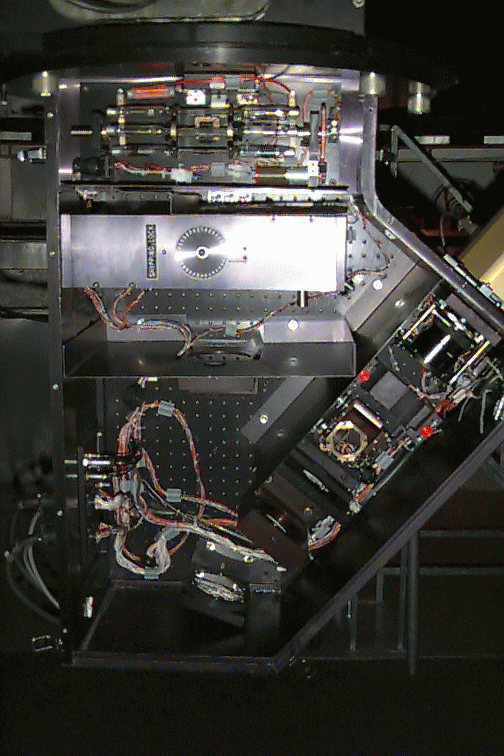
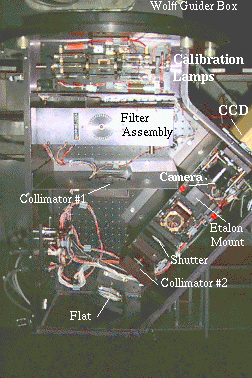
View of the IFPS optical bench, showing the optics, calibration
lamps, and filter-wheel assembly (200Kb GIF). An
annotated version is available.
Instrument Schematic (41Kb PostScript)
Optical Layout (29Kb PostScript)
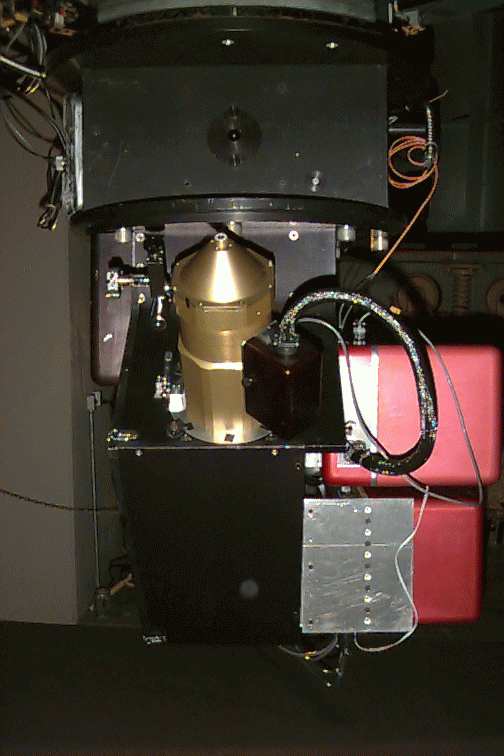
Side view of the IFPS on the 1.8m Telescope
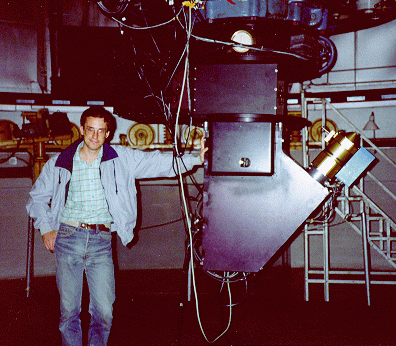
View of the IFPS on the 1.8m Perkins Telescope, Flagstaff, AZ, with an
astronomer shown for scale.
Sample IFPS Data

H-alpha emission-line Flux and H-alpha velocity map of a nuclear HII-region ring in the central 30-arcseconds of NGC 3351.

Ionization map of the Ring Nebula (21Kb GIF), composed of three
emission-line images taken through narrowband filters isolating particular
bright emission lines. Coding: Red=[OI]6300, Green=[OIII]5007, Blue=HeII
4686
Also available as a 408KB 24-bit TIFF
Ring Nebula [S II] Data (41Kb PostScript), a combination flux and spectrum grid in a sub-window.