
|
Astronomy 161
Introduction to Solar System Astronomy
Prof. Paul Martini
|
Lecture 14: Galileo
Key Ideas
- Galileo Galilei: the first modern astronomer
- Important discoveries with the telescope:
- Moons of Jupiter
- Phases of Venus
- Craters and Mountains on the Moon
- Sunspots
- Confrontation with the Church
Galileo Galilei (1564-1642)
- Italian contemporary of Kepler
- Gifted mathematician
- Brilliant observer and experimenter
- Preferred experimentation and measurement to philosophical rhetoric
- Staunch anti-Aristotelian
- Often at odds with the scholarly establishment
The Telescope
- The telescope was invented in 1608 by Hans Lipperhey, a Dutch spectacle maker
- The invention spread fast:
- In April 1609 you could buy one in eyeglass shops in Paris
- First one reached Italy in August of 1609
Galileo's Telescope
- Galileo learned about the telescope in 1609, but did not get a chance to see one
- Based on a description, and acquainted with lens making, he made his own
- Solved many technical problems, and came up with a design that produced good-quality images with a magnifying power of 20x
- Soon pointed his telescope at the night sky...
"...a most beautiful and delightful sight"
- 1610: published his observations as the Sidereus Nuncius
(The Starry Messenger)
- Later observations were published in letters and in a longer work, The Assayer, in 1623
- The most important observations were:
- Craters and Mountains on the Moon
- Sunspots and Solar Rotation
- Moons of Jupiter
- Phases of Venus
Moon Craters and Mountains
- Galileo saw craters and mountains on the Moon
- The Moon was not a smooth, perfect sphere as taught by Aristotle and Ptolemy
- The surface was "...rough and uneven, and just like the surface of the Earth itself..."
- Galileo was able to measure the heights of lunar mountains using their shadows
- The Moon was another world like the Earth
Spots on the Sun
- Galileo observed sunspots
- The bright surface of the Sun had dark spots that changed and moved across its surface
- He discerned solar rotation (about 27 days)
- The Sun was not a perfect body and it was rotating about its axis
- If a huge object like the Sun is rotating, why not the Earth?
Moons of Jupiter
- Galileo discovered 4 moons orbiting Jupiter
- Jupiter appeared as a disk
- 4 points of light follow it and move around it
- Deduced that they were moons of Jupiter
- Concluded that the Earth is not the only center of motion in the Universe
Phases of Venus
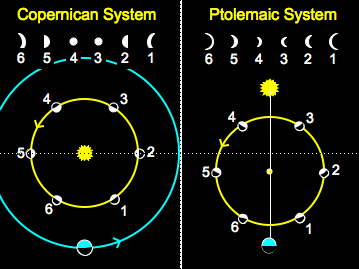
- Venus goes though phases like the Moon
- Sequence of phases and changes in diameter proved conclusively that Venus orbits the Sun
- Ptolemaic theory predicts the opposite of what is observed with the telescope
- The Sun was also a center of Motion
- Didn't prove the Copernican system (it was also consistent with the Tychonic system)
- Profoundly damaging to the Ptolemaic system
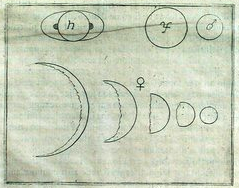 Galileo's drawing of the phases of Venus from The Assayer (1623)
Impact of Galileo's Observations
- The impact was immediate and forceful:
- Kepler was delighted, and soon got his own telescope, as did many others
- Many scholars began to take the Copernican system seriously as a physical description
- Hardcore skeptics claimed that the telescope was lying (and Galileo too) and entrenched
- With the telescope, everyone could literally "see for themselves"
Troubles with the Church
- 1616:
- The Church officially declared that the heliocentric theory is "philosophically false and at least an erroneous belief"
- De Revolutionibus is officially banned
- Galileo was called to an audience with Cardinal Robert Bellarmine, who
cautioned him verbally to stop teaching and defending the Copernican model
in public
Galileo's "Dialogue"
- 1624:
- Galileo writes "A Dialogue on the Two Cheif World Systems," ably defending the Copernican System
- Seeks permission from Pope Urban VIII to publish it, but is only allowed to discuss it as a mathematical proposition
- 1632:
- Galileo's "Dialogue" is published in Florence, written in Italian (Tuscan), not Latin
- It was an instant success and widely acclaimed
The Trial of Galileo
- 1633:
- Galileo is summmoned by the Roman Inquisition and a document is produced alleging that Bellarmine in 1616 specifically forbade him to discuss the Copernican system in any way
- Galileo faced two charges:
- Disobedience of Bellarmine's 1616 order
- Misleading the censors who granted permission to publish the Dialogue
Errors and Heresies
- Enemies of Galileo convinced Pope Urban VIII that a character in the Dialogue named Simplicio (who ineptly defended Ptolemy) was a thinly veiled caricature of the Pope
- Publicly humiliated and threatened with torture, Galileo had no choice but to admit guilt, and "abjure, curse, and detest the aforesaid errors and heresies..."
House Arrest
- Galileo was placed under house arrest at his villa in Arcetri near Florence until his death in 1642
- Despite this, in 1636 he finished "The Two New Sciences" describing his earlier experiments in mechanics
- They were published in Protestant Leyden in 1638
- Laid the foundations of classical physics
Eppur si muove (and still, it moves)
- Galileo spent his final 4 years in blindness, and died under house arrest, on January 8, 1642
- On Christmas Day of that same year, Isaac Newton was born in Woolsthorpe, England
- In 1992, 350 years later, Pope John Paul II officially declared Galileo innocent
See A Note about Graphics to learn
why some of the graphics shown in the lectures are not reproduced with
these notes.
[
Return to the Astronomy 161 Main Page
|
Unit 3 Page
]
Updated: 2010 January 23
Copyright © Paul Martini All Rights
Reserved.