
|
Astronomy 161
Introduction to Solar System Astronomy
Prof. Paul Martini
|
Lecture 18: Resonances
Key Ideas:
- Every object in the Solar System feels gravitational pulls from all of the other objects
- Three-Body Problem
- Lagrange Points
- Earth-Moon and Sun-Jupiter Systems
- Gravitational Interactions
- Long-Range Perturbations (discovery of Neptune)
- Close Encounters (slingshot effect)
- Resonances
- Orbital (Mean-Motion) Resonances
Beyond Kepler
- Newton's formulation of Kepler's Law only strictly applies to idealized systems with only 2 massive bodies orbiting each other
- The Solar System is a "many-body" system
- Eight planets
- Multiple moon systems
- Millions of small Asteroids and Icy Bodies
- Lots of smaller debris (meteors and comets)
- How can one calculate these effects?
The Three-Body Problem
- What is the orbit of a small body in the combined gravitational field of two larger objects orbiting each other?
- Spacecraft in the Earth-Moon System
- Asteroid orbiting the Sun near Jupiter
- Solution by Joseph Lagrange (1736-1813)
- Solved the "Restricted" 3-body Problem
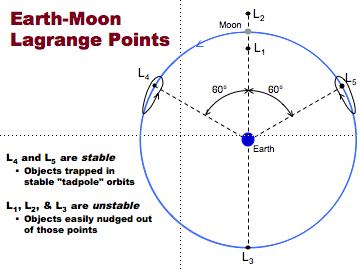
- Found 5 "islands of equilibrium" that orbit in lock-step with the main 2 bodies
- Lagrange Points
- L1, L2, and L3 are unstable, while L4 and L5 are stable
Gravitational Interactions
- To a first approximation, most orbits around the Sun are 2-body Keplerian orbits:
- The Sun is ~1000x more massive than all the planets, moons, and small bodies combined
- The Solar System is mostly empty, with large distances between big objects
- Since gravity is an inverse-square law force:
- Gravity from other bodies is much less than the Sun's gravity
- But the effects can accumulate over time
- Or can be large in close encounters
Long-Range Perturbations
- Long-range interactions between two massive bodies orbiting the Sun
- Extra gravitational forces accelerate the bodies relative to their Keplerian orbits:
- "Perturbed" from simple Keplerian paths
- Strongest when the two bodies are lined up at opposition (closest approach)
- Less massive objects experience stronger acceleration (a = F/m)
- Effects accumulate over time, although in most cases they cancel out
The Discepant Orbit of Uranus
- In 1781, William Herschel accidentally discovered the 7th planet Uranus
- By 1840, the discrepancies between the predicted and actual positions of Uranus were larger than 1 arcminute
- Perturbation was larger than predicted from the gravity of the known planets combined
- This suggested the extra acceleration was from an 8th, unknown planet
orbiting beyond Saturn.
The Discovery of Neptune
- Calculations predicted the location of the new planet
- Performed by Urban LeVerrier in France and John Couch Adams in England
- 1846 Sept 23: Galle in Berlind found Neptune only 52 arcminutes from the predicted spot!
- This was another predictive triumph of Newtonian Gravity!
Close Encounters
- Close encounters between objects have much stronger effects:
- Dramatically alter orbits of one or both bodies
- Smaller objects are more strongly affected
- Examples
- Comet perturbed into a new orbit after a close encounter with Jupiter
- Gravity assist from Jupiter to accelerate a spacecraft into the outer Solar System
- Gravity assists from the Earth and Venus to decelerate a spacecraft into the inner Solar System
Orbital Resonances
- Small perturbations at opposition usually happen at different places along the orbit
- Effects average out over long times
- But, if the periods are whole-number ratios, get regular, periodic perturbations at the same place in the orbit
- Repeated tugs add up over time
- Regular close encounters destabilize orbits, but
- If synchronization avoids close encounters, the orbit can stabilize
Naming Resonances
- Named by the number of orbits completed by each body in the same time
- First number = number of orbits completed by the dominant (most massive) body
- Second number = number of orbits completed in the same time by the smaller body
- Examples:
- Pluto 3:2 resonance with Neptune (3 Neptune orbits for every 2 Pluto orbits)
- Asteroid Hilda in a 2:3 Resonance with Jupiter (2 Jupiter orbits for every 3 Hilda orbits)
Solar System Resonances
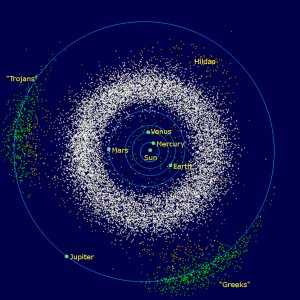
- Main Asteroid Belt - Resonances with Jupiter
- Kirkwood Gaps (unstable resonances)
- Asteroid Families (stable resonances)
- Trojan Asteroids - 1:1 resonance with Jupiter
- Kuiper Belt resonances with Neptune
- Pluto and Plutinos in 3:2 resonance orbits
- Twotinos - objects in 2:1 resonance orbits
- Jupiter and Saturn Systems
- Jupiter: 1:2:4 Laplace Resonance of the moons Io, Europa, and Ganymede
- Saturn: resonance moons and Ring gaps
Dynamical Evolution
- The Solar System is not a static "clockwork"
- The dynamical state changes over time as the planets interact gravitationally
- Resonances can amplify these effects:
- Some resonant orbits are unstable and get depopulated
- Others are stable and objects are swept into them where they form distinct dynamical families
- Both have helped dynamically "shape" the Solar System over its long history
See A Note about Graphics to learn
why some of the graphics shown in the lectures are not reproduced with
these notes.
[
Return to the Astronomy 161 Main Page
|
Unit 4 Page
]
Updated: 2010 February 2
Copyright © Paul Martini All Rights
Reserved.