
|
Astronomy 161
Introduction to Solar System Astronomy
Prof. Paul Martini
|
Lecture 21: Matter
Key Ideas:
- Atoms are composed of
- a nucleus of protons and neutrons
- orbiting electrons
- Chemical Elements and Isotopes
- Radioactivity
- Four Fundamental Forces
- Gravitational and Electromagnetic
- Strong and Weak Nuclear Forces
Atoms
- Ordinary matter is found primarily in the form of atoms
- The word atom comes from the Greek word atomos, which means
indivisible
- Range of ordinary matter:
- Free subatomic particles (protons and electrons)
- Single atoms (hydrogen, helium, gold, etc.)
- Simple molecules (O2, H2O, etc.)
- Macromolecules (DNA, complex polymers, oil, etc.)
- Macroscopic objects (diamonds, trees, people, planets, etc.)
The Gold Foil Experiment
- Early models of the atom assumed atoms had uniform density
- In 1909 Hans Geiger and Ernest Marsden shot charged particles (called alpha particles) through a thin sheet of gold foil
- Surprisingly, about 98% went straight through, 2% were deflected, and 0.01% bounced straight back!
- The Atom was nearly empty!
Atomic Structure
- Nucleus of a heavy subatomic particles:
- proton: positively charged
- neutron: uncharged (neutral)
- Electrons orbiting the nucleus
- negatively charged particles
- 1/1836th the mass of a proton
- Atoms are mostly empty space
- Only 1 part in 1015 of space is occupied
- The rest of the volume is threaded by electromagnetic fields
Chemical Elements
- Atoms are separated into distinct Elements by the number of protons in
the nucleus
- Atomic Number:
- 1 proton: Hydrogen
- 2 proton: Helium
- 3 proton: Lithium
- Number of electrons = Number of protons
- All elements are Chemically Distinct
- An atom is the smallest division of a chemical element
Top Ten Most Abundant Elements
- 10) Sulfur
- 9) Magnesium
- 8) Iron
- 7) Silicon
- 6) Nitrogen
- 5) Neon
- 4) Carbon
- 3) Oxygen
- 2) Helium
- 1) Hydrogen
Variation in Abundance
- The average abundances of elements in the Universe need to be measured over a large Volume
- For example, the entire Solar System (at least)
- Local variations can be significant
- Oceans mostly Hydrogen and Oxygen (in water)
- Earth's crust mostly Oxygen, Silicon, Aluminum, and Iron
Known Elements
- 117 elements are currently known:
- 87 are metals
- 11 are gasses
- 2 occur as liquids (Bromine and Mercury)
- 26 are naturally radioactive
- 24 are made only in particle accelerators
- In addition, each element can have a number of different isotopes
Isotopes
- A given element can have many Isotopes
- Same number of protons
- Different number of neutrons
- Example:
- 12C has 6 protons and 6 neutrons
- 13C has 6 protons and 7 neutrons
- 14C has 6 protons and 8 neutrons
- These are chemically identical, but have different masses
Radioactivity
- Discovered by Antoine Becquerel in 1896, who observed that Uranium would fog photographic plates
- If a nucleus has too many or too few neutrons, it is unstable to radioactive decay
- Examples:
- 3H (1p + 2n) decays to 3He (2p + 1n) + 1 electron + 1 neutrino
- 14C (6p + 8n) decays to 14N (7p + 7n) + 1 electron + 1 neutrino
- This later reaction is the basis of radiocarbon dating
- Free neutrons are also unstable
- n decays to p + 1 electron + 1 neutrino
Radioactive Half-Life
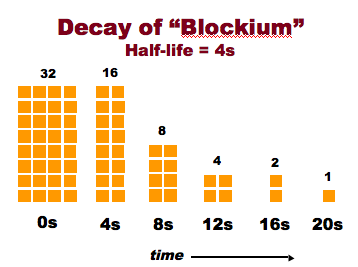
- Radioactive decay is a random process
- The activity is measured by the Half-Life
- Time for half of the atoms to decay
- The more radioactive, the shorter the half-life
- Examples:
- 3H (1p + 2n) decays to 3He (2p + 1n) + 1 electron + 1 neutrino with a 12.26 year half-life
- 14C (6p + 8n) decays to 14N (7p + 7n) + 1 electron + 1 neutrino with a 5730 year half-life
- n decays to p + 1 electron + 1 neutrino with a 12 minute half-life
Uranium
- 238U has a half-life of 4.51 x 10⁹ years. The vast majority of natural Uranium is in this isotope
- 235U has a half-life of 7 x 10⁸ years. It is consequently very rare, but it produces lots of neutrons when it decays and can therefore sustain nuclear reactions (either for power or bombs)
Fundamental Forces of Nature
- All interactions in nature are governed by four "fundamental" forces
- Gravitational Force
- Electromagnetic Force
- Strong Nuclear Force
- Weak Nuclear Force
Gravitational Force
- Gravitation binds matter over long distances
- Long-range attractive force
- Weakest force of nature
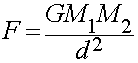
- Obeys the Inverse Square Law of distance:
Electromagnetic Force
- Electromagnetic force acts between charged particles
- Like charges repel each other
- Opposite charges attract each other
- Long-range, inverse-square law force:
- Binds electrons and protons into atoms
- Binds atoms together into molecules
- Very strong:
- 1039 times stronger than Gravity
Strong and Weak Nuclear Forces
- Short-range forces (<10-15m) in atomic nuclei
- Strong force:
- Binds protons and neutrons into nuclei
- Strongest force of nature
- Weak force:
- Responsible for radioactivity (what turns a neutron into a proton, electron, and neutrino during neutron decay)
- Second strongest force
The Interplay of Forces
- Gravity rules on the largest scales:
- Binds massive objects together
- Controls orbital motions
- Electromagnetism rules on atomic scales
- Binds electrons to protons and atoms to atoms
- Mediates chemical reactions
- Strong and Weak Forces rule on nuclear scales
- Binds protons to neutrons inside nuclei
- Mediates radioactivity and nuclear reactions
See A Note about Graphics to learn
why some of the graphics shown in the lectures are not reproduced with
these notes.
[
Return to the Astronomy 161 Main Page
|
Unit 4 Page
]
Updated: 2010 January 30
Copyright © Paul Martini All Rights
Reserved.