

|
Astronomy 161
Introduction to Solar System Astronomy
Prof. Paul Martini
|
Lecture 25: The Age of the Earth
Key Ideas:
- Different Age Determinations
- Ages based on Human History
- Pre-20th century physical ages
- Radiometric Dating
- Employs radioactive isotopes
- Measures the time since the rock solidified
- Old rocks, moon rocks, meteorites
- The Earth is 4.6 +/- 0.1 Billion years old
- Determined from radiometric dating
Historical Ages of the Earth
- Eusebius of Caesarea (AD 260-340):
- 3184 BC, based on biblical chronology
- Kepler:
- 3993 BC, combining biblical and other sources
- Hevelius:
- October 24, 3963 BC at 6pm
- Newton:
- 3998 BC, including the voyage of the Argonauts as a historical event
The Central Assumption
- All of these dates are based upon the same assumption:
- Human history can be equated with the physical history of the Earth
- Why do they all get 4000 BC?
- It roughly corresponds with the invention of writing, and thus the earliest historical records
Is this central assumption correct?
Edmund Halley
- Physical estimate
- Rivers wash salts into the oceans
- Oceans get more salty over time
- Time required for an initially fresh-water ocean to achieve its current salinity:
- If a few 1000 years, the oceans would be fresh
- If infinite, the oceans would be saturated with salts like the Dead Sea
- John Joly (1890s) estimated 80-90 Myrs
George-Louis Leclerc
- Comte de Buffon (1707-1788)
- Naturalist and Geologist
- Age based on cooling:
- Estimated the time needed for a molten Earth to cool down
- Experimented with hot iron spheres and scaled up to an Earth-sized mass
- Got an age of ~75,000 years
- Kelvin (1897) revised this to 20-40 Myr
James Hutton (1726-1797)
- Theory of the Earth (1795)
- Founder of modern geology
- Described repeated cycles of uplift and erosion in the geology of the land:
- Introduced "repair" into geological history
- Previous idea was decay from an initial creation
- Concluded Earth was millions of years old
- But, he also asserted that the cycle of decay and repair erased much of this history
Charles Lyell (1797-1875)
- Principles of Geology
- 11 editions between 1830 and 1872
- Doctrine of Uniformitarianism:
- Earth undergoes perpetual, uniform change, not just change in response to catastrophe
- Stratographic Ages: Rock strata separate ages of gelogical history
- Changes in fossils found in strata can fix their relative ages
- Friend of Charles Darwin, who thought even 400 Myr was not old enough for natural selection
Role of Radioactivity
- Radioactivity was discovered by Becquerel in 1896
- Marie and Pierre Curie and Albert Laborde showed that radioactivity produces heat
- George Darwin and John Joly realized (1903) that this heat would increase age estimates
- Subsequent work also showed that radioactive decay could be used as an accurate chronometer for rocks
Radioactive Isotope Dating
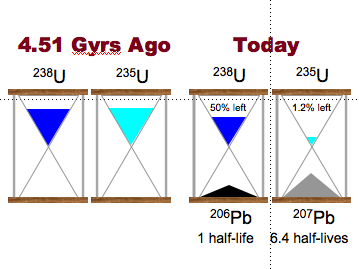
- Consider a rock that solidified containing two Uraniam (element U) isotopes: 238U and 235U:
- 238U turns into 206Pb with a half life of 4.47 Gyr
- 235U turns into 207Pb with a half life of 704 Myr
- Both lead (element Pb) isotopes are stable.
- Over time the rock will have:
- Less 238U and even less 235U
- More lead, but in different isotopic proportions
- Careful measurements can yield accurate ages via a technique called radiometric dating
The Role of Zircon
- Zircon (ZrSiO4) is a common mineral that is very important to radiometric dating
- This mineral will incorporate Uranium into its crystal structure when it forms, but not lead
- Measurement of the present day Lead (206Pb and 207Pb) and Uranium (235U and 238U) provide two independent age measurements of a rock
Time Since Solidification
- Once you make a rock
- Its elements are locked in
- Other elements are locked out
- The decay products of locked-in isotopes stay locked in
- Once you melt it
- Everything gets mixed up ("resets the clock")
Radiometric dating measures the time since the rock solidified
Radioactive Dating of the Earth
- The Problem: the Earth is geologically active
- Surface rocks are being melted and reprocessed (for example, the Rocky Mountains are only ~60 Myr old)
- Most of the crust is less than 100 Myr old
- The Solution: Find the oldest rocks
- Continental shields in Australia (4.3 Gyr) and Canada (3.96 Gyr)
- Moon rocks
- Meteorites
Age of the Earth
- Oldest surface rocks known are 4.3 Gyr old (Australian Shield)
- Moon Rocks and Meteorites:
- Ages of 4.6 Gyr with spread of about 100 Myr
- Implies rapid formation of planetary material
- The best estimate of the age of the Earth is 4.6 +/- 0.1 Gyr
See A Note about Graphics to learn
why some of the graphics shown in the lectures are not reproduced with
these notes.
[
Return to the Astronomy 161 Main Page
|
Unit 5 Page
]
Updated: 2010 February 7
Copyright © Paul Martini All Rights
Reserved.