
|
Astronomy 161
Introduction to Solar System Astronomy
Prof. Paul Martini
|
Lecture 29: Overview of the Solar System
Key Ideas:
- The Solar System contains:
- The Sun
- Terrestial Planets
- Jovian Planets
- Giant Moons
- Dwarf Planets
- Smaller rocky and icy bodies (asteroids, comets, etc.)
The View from Afar
- What observations can we make of the planets without leaving Earth?
- Orbits: direction, ellipticity, tilt (or inclination), distance
- Rotation: speed, tilt
- Number and sizes of moons
- Masses and radii (and thus density)
- Reflectivity, presence of craters
- Spectroscopy (temperature, chemical composition)
The Neighbors
- Sun
- A star (middle-aged, average-sized)
- Terrestrial Planets
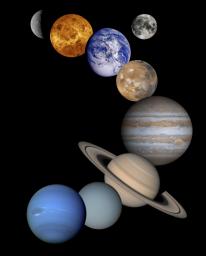
- Rocky planets: Mercury, Venus, Earth, Mars
- Jovian Planets
- Gas/Ice giants: Jupiter, Saturn, Uranus, Neptune
- The Rest
- Dwarf Planets: Pluto, Eris, Ceres
- Giant Moons
- Icy bodies: Icy moons, Kuiper Belt Objects, Comets
- Rocky bodies: Asteroids
Basic Properties of the Planets
- Location:
- Terrestrial in the inner solar system: 0.4 - 1.5 AU
- Jovian in the outer solar system: 5 - 30 AU
- All orbit in the same direction and same plane:
- Orbit counterclockwise, in the same sense as the rotation of the
Sun
These facts provide clues to the formation of the Solar System
The Sun
- A middle-aged, average star:
- Mostly Hydrogen and Helium
- 99.8% of the entire Solar System
- About 4.6 Gyr old
- Shines because it is hot:
- Surface temperature ~6000 K
- Mostly emits UV, visible, and infrared light
- Kept hot by nuclear fusion in its core
- Builds Helium from Hydrogen fusion
- Can shine for ~12 Gyr
The Sun contains nearly all of the mass in the Solar System
The abundance of the Sun is nearly equal to that of the entire Solar System
Terrestrial Planets
- Mercury, Venus, Earth, and Mars
- "Earth-like," rocky planets
- Largest is the Earth
- Only found in the inner solar system (0.4 to 1.5 AU)
- Rocky Planets:
- Solid surfaces
- Mostly silicates and iron
- High density: 3.9-5.5 g/cm3 (rock and metal)
- Earth, Venus, and Mars have atmospheres
Jovian Planets
- Jupiter, Saturn, Uranus, and Neptune
- Largest planets: at least 15 times the mass of the Earth
- Jupiter is the largest at 318 Earth masses
- Only found in the outer solar system (5 to 30 AU)
- Gas Giants:
- No solid surfaces (mostly atmosphere)
- Mostly Hydrogen and Helium
- Rocky/icy inner cores
- Low density: 0.7 to 1.7 g/cm3 (compare to water at 1 g/cm3)
The Giant Moons
- Natural satellites orbiting planets
- Giant Moons:
- Earth: The Moon
- Jupiter: Io, Europa, Ganymede, and Callisto
- Saturn: Titan
- Neptune: Triton
- Many smaller moons, both rocky and icy
- Many dwarf planets have small moons
- Only Mercury and Venus have no moons
Getting Goofy Over Pluto
- The discovery of additional, 'pluto-sized' objects in the outer
solar system led to a recent reconsideration of the definition of a planet
- In August 2006 the International Astronomical Union adopted the new
category of 'dwarf planet'
- A Dwarf Planet is defined to be a celestial body that:
- Is in orbit around the Sun
- Must be in hydrostatic equilibrium due to its mass (must be round)
- Has not cleared the neighborhood around its orbit
- Is not a satellite
The Dwarf Planets
- Five official (so far):
- Pluto: Formerly the ninth planet, now the second-largest dwarf planet
- Ceres: Largest member of the asteroid belt
- Eris: Largest dwarf planet, whose discovery started the controversy
- Haumea
- Makemake
Trans-Neptunian Objects
- Any object that orbits at the distance of Neptune or beyond
- Three regions
- Kuiper Belt from 30-50 AU (e.g. Pluto)
- Scattered Disk out to 100s of AU (e.g. Eris, Quaoar)
- Oort Cloud postulated to exist 50,000 to 100,000 AU from the Sun (e.g. Sedna???)
- More than 1000 objects orbit beyond Neptune. Only a small number (e.g. Pluto and Charon) were known
prior to 1992.
The Leftovers (Minor Bodies)
- Asteroids:
- Made of rock and metal (density of 2-3 g/cm3)
- Sizes: 500 km (Ceres) to large boulders
- Meteoroids:
- Bits of rock and metal
- Sizes: grains of sand to boulders
- Comets:
- Composite of rock and ice ("dirty snowballs")
- Long tails of gas and dust are swept off them when they pass near the Sun
See A Note about Graphics to learn
why some of the graphics shown in the lectures are not reproduced with
these notes.
[
Return to the Astronomy 161 Main Page
|
Unit 6 Page
]
Updated: 2010 February 14
Copyright © Paul Martini All Rights
Reserved.