
|
Astronomy 161
Introduction to Solar System Astronomy
Prof. Paul Martini
|
Lecture 31: Sunny Mercury
Key Ideas:
- Mercury is the innermost planet and the smallest planet in the Solar System
- Rotation is locked in a 3:2 tidal resonance
- Surface:
- Heavily cratered
- Virtually no atmosphere
- Interior
- Large iron core and weak magnetic field
- Weak tectonic activity (wrinkles as it cools)
- Importance of Giant Impacts
3:2 Tidal Resonance
- Mercury's rotation period is exactly 2/3 its orbital period
- In a 3:2 Tidal Resonance with the Sun
- Completes 3 rotations for every 2 orbits
- Caused by its highly elliptical orbit
- Tides are strongest at perihelion (closest to Sun)
- Rotation is the same as if it were in a circular orbit at its perihelion
distance and tidally locked
Surface of Mercury
- First imaged by Mariner 10 in 1974 and 1975
- Messenger launched in 2004 for 2008, 2009 flybys and 2011 orbit
- Mercury is heavily cratered like the Moon
- Surface is 3.8-4 Gyr old like the lunar highlands (last epoch of heavy bombardment)
- Craters are flatter than lunar craters because Mercury's gravity is 2 times stronger
- Terrain features:
- Highlands and lava basins like the Moon
- Caloris Basin: Huge ringed impact basin
- Lobate scarps and jumbled terrain
Caloris Basin
- Impact Basin
- Large asteroid impact punched through crust
- Left a ringed basin 1340 km across
- Smooth in the center, similar to lunar maria (indicates magma)
- Albedo of center is similar to rest of surface (unlike lunar maria)
- Antipodes
- Disrupted terrain where the seismic waves from the impact converged
- May also be where ejecta converged
Mercury's Atmosphere
- Mercury has virtually no atmosphere
- Pressure is 10-12 times that of Earth's atmosphere
- H and He captured from the Solar Wind, held only temporarily
- Atoms of Sodium and Calcium knocked out of rocks by energetic solar wind particles
- Lost its primordial atmosphere
- Too low mass for gravity to hold it
- Too hot because close to the Sun
Surface Temperatures
- Since Mercury has no atmosphere, there are extreme Day/Night temperature changes:
- Daytime: 500 K (441 F)
- Nighttime: 100 K (-279 F)
- Some daytime locations are as hot as 600 K
- Poles are in perpetual twilight
- Axis has virtually no tilt
- Polar soil is cold: 125 K (-234 F)
- High reflectivity of some craters suggest ice
Mercury's Interior
- Mercury is between the Moon and Mars in size
- Thinner lithosphere than the Moon, but thicker than Earth or Mars
- Lobate Scarps:
- Thrust faulting (cliffs)
- Signs of tectonic disturbance, but NOT plate tectonics
- The lithosphere wrinkles as the interior cools and contracts
Deep Interoir
- Rocky mantle ~700 km thick
- Unexpectedly large iron core
- ~75% of the radius of Mercury!
- Contains ~60% of the planet's mass
- Revealed by:
- Weak magnetic field: ~1% as strong as Earth's
- High density: 5.43 g/cm3
- Compare to Mars (3.9 cm3), which is a larger planet
- Almost as dense as the Earth, yet Mercury is not as compressed
Origin of the Core
- Leading idea: head-on collision
- Collider was smaller than Mercury
- Impact blew off most of Mercury's mantle
- Re-formed planet had a huge iron core left behind
- Alternative idea is that the proto-Sun vaporized the original surface
- The weak magnetic field is likely due to the dynamo effect
- Circulation in the liquid, iron-rich core
Attraction of Satellites
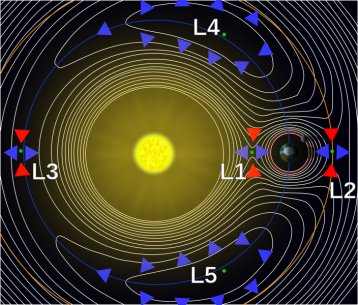
- The Hill Sphere is the region around a body where its gravity
dominates over all others
- The radius is

- For Mercury, this is only 220,000 km
Planetary Impacts
- Impacts between planets and asteroid-sized bodies have played an important role in determining the properties of the planets
- In the case of Mercury, a large head-on impact is invoked to explain its unusually large iron core
Impacts are an essential part of the history of the Solar System
See A Note about Graphics to learn
why some of the graphics shown in the lectures are not reproduced with
these notes.
[
Return to the Astronomy 161 Main Page
|
Unit 6 Page
]
Updated: 2010 February 22
Copyright © Paul Martini All Rights
Reserved.