
|
Astronomy 161
Introduction to Solar System Astronomy
Prof. Paul Martini
|
Lecture 36: Moons of Jupiter
Key Ideas:
- Jupiter has 63 known moons
- 8 are Regular Satellites
- Prograde orbits, small orbital inclination
- Most likely formed with Jupiter
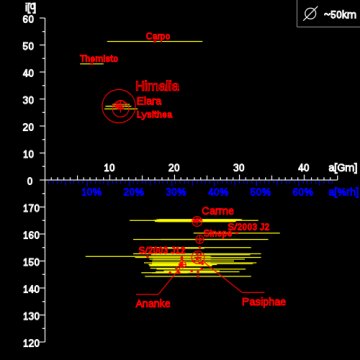
- 55 are Irregular Satellites
- Mix of prograde and retrograde, large inclinations
- Most likely captured by Jupiter's gravity
- Four of the regular satellites are Giant Moons
- Large (>3000 km), spherical, and differentiated
- Io is volcanically active
- Europa may have an ocean below the ice
Formation of Jupiter
- Inner, regular satellites likely formed in a circumplanetary disk
- Outer, irregular satellites were captured later
Innermost Moons
- All are tidally locked to Jupiter
- Metis and Adrastea orbit faster than Jupiter rotates
- Source of Jupiter's rings
Outermost Moons
- Irregular satellites
- Retrograde orbits are more common than prograde orbits
- Many moons share common orbital and physical properties
- These orbital families likely have a common origin
- They are probably pieces of a larger body than broke up in a collision
The Galilean Moons
- In circular orbits in the same direction around Jupiter
- Orbital Periods:
- Io: 1.8 days
- Europa: 3.6 days (2:1 orbital resonance with Io)
- Ganymede: 7.2 days (4:1 orbital resonance with Io)
- Callisto: 16.7 days
- All are tidally locked to Jupiter
Volcanically Active Io
- Tidal heating by Jupiter (and Europa) due to elliptical orbit
- Interior is molten silicates and sulfur
- Active eruptions and pools of molten sulfur
- Most volcanically active world in the Solar System
- Constant stretching and squeezing keeps Io molten
- The closest moon to Jupiter shows the most geological activity
Smooth Europa
- Icy surface covering a large, rocky core
- Surface is very smooth and young
- Fractured into ice rafts and floes a few kilometers across
- Repaved by water geysering through the cracks in the ice
- Does Europa have liquid water? Two ideas:
- 100-200 km of ice above a rocky core
- Thin ice crust over a 150 km deep water ocean
- If there is liquid water, life may be present
Groovy Ganymede
- Solar System's largest moon
- Density of 1.9 g/cc
- Thick ice mantle over rocky core
- May have a liquid water layer
- Grooved terrain:
- 10 km wide and 300 meters deep
- < 2 Gyr old based on the number of impact craters seen on top of them
Cratered Callisto
- Outermost Galilean moon
- Heavily cratered, dirty-ice surface
- Inactive for ~4 Gyr
- Craters are bright, with clean ice
- Density is 1.8 g/cc
- Ice layered on a rocky core
- May have a liquid water layer
Galilean Moons in Comparison
- Io and Europa are mostly rock:
- Mean densities of 3.5 and 3.0 g/cc, respectively
- Io: rocky crust, molten mantle, and active volcanoes
- Europa: icy lithosphere and rocky core
- Ganymede and Callisto are mixed ice and rock
- Mean densities of 1.9 and 1.8 g/cc, respectively
- Deep ice mantles over rocky/icy cores
- Less geologically active
Formation of the Galilean Moons
- Inner moons are rocky and dense
- Outer moons are a mixture of rock and ice
- Jupiter was hotter when they formed
Interior Heat
- In the terrestrial planets, interior heat is determined by the planet's size:
- Largest (Earth and Venus) have hot interiors
- Smaller (Mercury and Mars) have cold interiors
- In the Galilean moons, interior heat is determined by proximity to Jupiter
- Io is hottest, outermost Callisto is coldest
- Energy source: tidal heating by Jupiter
See A Note about Graphics to learn
why some of the graphics shown in the lectures are not reproduced with
these notes.
[
Return to the Astronomy 161 Main Page
|
Unit 6 Page
]
Updated: 2010 February 28
Copyright © Paul Martini All Rights
Reserved.