
|
Astronomy 161
Introduction to Solar System Astronomy
Prof. Paul Martini
|
Lecture 38: Ice Giants: Uranus and Neptune
Key Ideas:
- The outermost planets
- Nearly identical structure and composition
- Called Ice Giants because of chemical content, not because they are solid ice
- Uranus:
- Lacks internal heat and so nearly featureless
- Axis tilted by 98 degrees, results in extreme seasons
- Neptune:
- Has internal heat and an active atmosphere
- One Giant Moon: Triton
- Migration of the Outer Solar System
Spacecraft studies
- Voyager 2 flew past Uranus and Neptune
- Uranus: January 1986
- Neptune: August 1989
- Both planets have been extensively studied using the Hubble Space Telescope
- Long-term monitoring of weather patterns
- Infrared imaging studies of their atmospheres, rings, and moons
Interiors of Uranus and Neptune
- Rocky cores
- Slushy, "ice" mantles
- Molecular hydrogen in their outer layers
- Presence of Methane in the outer atmosphere gives them their characteristic blue appearance
Magnetic Fields
- All Jovian planets have strong magnetic fields
- Jupiter's is the strongest by far
- The other are similar in extent and strength
- Provide the best way to measure rotation periods
- Uranus and Neptune have off-center fields
- Magnetic and rotation axes are very misaligned (59 degrees for Uranus, 47 degrees for Neptune)
- Fields are off-center as well (30 percent for Uranus, 55 percent for Neptune)
Uranus' Atmosphere
- Uranus is a virtually featureless, hazy blue ball
- Lacks source of internal heat
- Clouds are cold and do not billow above the top layers
- Results in a generally uniform appearance
- Occasional clouds and storms seen in the infrared
Uranus' Extreme Seasons
- Uranus' axis is tilted ~98 degrees
- Lying on its side in its orbit
- Extreme seasonal variations:
- 1985: North pole in full Sun, South pole in darkness
- 2008: Sun on equator, twilight at poles
- 2027: South pole in full sunlight, north is dark
Neptune's Atmosphere
- Neptune radiates 2.7x as much energy as it gets from the Sun
- Active atmosphere
- Dark belts
- Bright clouds of methane ice
- Dark oval cyclonic storms
- "Great Dark Spot" and methane cirrus clouds
Moons of Uranus and Neptune
- Uranus has 27 moons
- None are large enough to be "giant moons"
- 5 icy, spherical moons; Miranda, Ariel, Umbriel, Titania, Oberon
- 22 tiny, irregular icy moons
- Neptune has 13 moons
- 1 Giant Moon: Triton, a very cold, icy moon
- Triton orbits retrograde
- 12 tiny, irregular icy moons
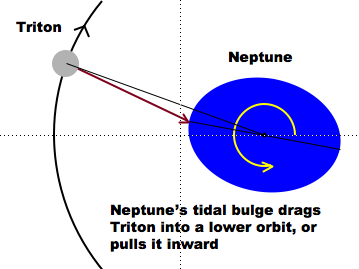
- Triton was likely captured by Neptune after the planet formed
- This capture probably destroyed the original moon system
Migration of Neptune
- There was probably not enough mass in the early solar system to form Neptune at its current location
- Neptune, and probably Saturn and Uranus, all migrated outwards from their original location
- They pushed out the remaining icy planetesimals
- Neptune captured many into orbital resonances
Planetary Migration
- Occurs when a planet interacts with a disk of gas or planetesimals
- Angular momentum is exchanged via 'gravitational scattering'
- Semimajor axes change leading to inward or outward migration
- Outward Migration of Neptune led to the resonant capture of Pluto (and other Plutinos) in the 3:2 orbital resonance
See A Note about Graphics to learn
why some of the graphics shown in the lectures are not reproduced with
these notes.
[
Return to the Astronomy 161 Main Page
|
Unit 6 Page
]
Updated: 2010 February 28
Copyright © Paul Martini All Rights
Reserved.