
|
Astronomy 161
Introduction to Solar System Astronomy
Prof. Paul Martini
|
Lecture 40: Outer Solar System
Key Ideas:
- Outer Dwarf Planets
- Pluto and its moons
- Eris and Dysnomia
- New Dwarf Planets
- Trans-Neptunian Objects
- Kuiper Belt and Resonances
- Scattered Disk
- Oort Cloud
Frozen Pluto
- Pluto is a cold, icy world
- Temperature: 35-45K
- Density is about 2 g/cc with a rocky core and an icy mantle
- Surface covered with frozen N2 mixed with methane and traces of CO2 and water
- Thin N2 atmosphere
- New Horizons mission to Pluto
- Launched January 19, 2006
- Pluto fly-by on July 14, 2015
- Explore the Kuiper Belt from 2016-2020
Eris
- New Dwarf Planet that ignited the Pluto controversy
- Slightly larger than Pluto
- One large moon Dysnomia
- How big is Eris?
- Too small to measure the angular size
- Size estimates are based on reflectivity
- If a perfect mirror, about as large as Pluto
- If as reflective as Pluto, it is 25 percent larger
- If as reflective as Charon, it is 50 percent larger
Remaining Dwarf Planets
- Makemake
- 310 year period
- Third-largest dwarf planet
- Discovered in 2005
- Haumea
- 283 year period
- Two moons
- Discovered in 2004
- Both were classified as dwarf planets in 2008
What is a Dwarf Planet?
- A Celestial Body that
- 1. Is in orbit around the Sun
- 2. Must be in hydrostatic equilibrium due to its mass (i.e. round)
- 3. Has not cleared the neighborhood around its orbit
- 4. Is not a satellite
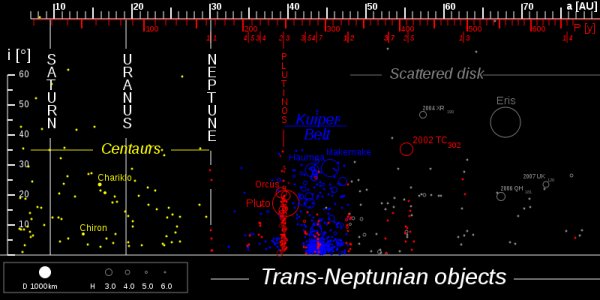
Trans-Neptunian Objects
- Class of icy bodies that orbit beyond Neptune
- Divided into various sub-classes:
- Kuiper Belt Objects
- Scattered Disk Objects
- Oort Cloud
- Distinguished by their orbits
Kuiper Belt Objects (KBOs)
- Most Trans-Neptunian Objects are found in the Kuiper Belt
- Flattened region 30-50 AU from the Sun
- Split into those in and not in orbital resonance with Neptune
- First KBO discovered in 1992
- Many hundreds now known
- Estimates are that there are about 70,000 objects larger than 100km across
- Largest are greater than 1000 km
Plutinos and Twotinos
- Plutinos (little Plutos) are KBOs in a 3:2 orbital resonance with Neptune
- Complete 2 orbits for every 3 by Neptune
- Comprise ~25% of Trans-Neptunian Objects
- About the same period and semimajor axis as Pluto, but different eccentricities and orbital inclinations
- Twotinos are similar, but in 2:1 orbital resonance with Neptune
Scattered Disk
- Orbits bring them within Neptune's gravitational influence (not resonant)
- More distant and consequently less well studied
- Likely scattered to their present location during Neptune's migration
Oort Cloud
- Existence of long-period comets (>200 year) indicates a reservoir of icy bodies in the outer solar system
- In 1950 Jan Oort noted there were many comets with a~20,000 AU and their orbital inclinations were spherically distributed (not in the ecliptic plane)
- Up to billions of potential comet nuclei may be there
- Possibily composed of the primordial building blocks flung to the outer solar system by the giant planets
- Composition of long-period comets suggest primarily ices, although there may be some rocky bodies
- May extend to 50,000 AU from the Sun (nearly a light year)
- Total mass of the Oort cloud may be several times that of the Earth
See A Note about Graphics to learn
why some of the graphics shown in the lectures are not reproduced with
these notes.
[
Return to the Astronomy 161 Main Page
|
Unit 6 Page
]
Updated: 2010 March 7
Copyright © Paul Martini All Rights
Reserved.