
|
Astronomy 161
Introduction to Solar System Astronomy
Prof. Paul Martini
|
Lecture 43: Other Solar Systems
Key Ideas:
- Selection Effects
- Properties of Extrasolar Planets
- Giant planets very close to their parent stars
- Close and eccentric orbits
- Evidence for migration or interactions?
- Properties of the parent stars
- Planets rarer around small stars
- Planets rarer around metal-poor stars
Strange New Worlds
- Almost none of the systems found so far resemble our Solar System
- The biggest surprise is Jupiter-sized planets so close to their parent stars
- Deep inside the "Frost Line" where Jupiter-sized planets should not be able to form
- Many have orbits smaller than Mercury's!
- What is going on?
Selection Effects
- Vast majority of exoplanets have been found using the Doppler Wobble method
- Orbital speeds will be largest for
- Massive planets close to their parent stars
- In stars with lots of spectral lines (iron-rich)
- Implies that unusual systems will be easier to find than ones like our solar system
- This is an example of a Selection Effect
How long to detect Jupiter?
- Jupiter's orbital speed is 13 km/s
- The Sun moves in response at 13 m/s
- Jupiter's orbital period is 12 years
- Therefore it would take 12 years to see one orbit
Distribution of Orbital Periods
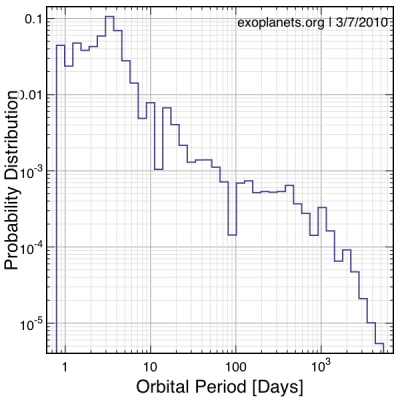
Basic Selection Ranges
- Doppler Wobble experiments started in the early 1990s, so only about 15 years of data:
- Would only find planets with P<15 years, really want to see at least 2 periods
- Recall: Jupiter has P=11.9 years, Saturn has P=29.5 years
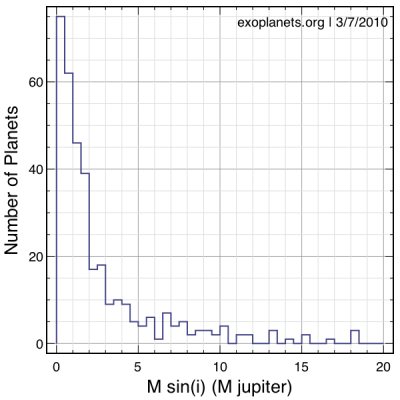
- Mass Limit: larger mass corresponds to faster orbital motion
- Current limits are ~3 meters per second
- Limited to Jupiter/Saturn masses at a few AU
- Down to Uranus/Neptune masses at <0.03 AU
Distribution of Exoplanet Masses
Hot Jupiters
- Jupiter-size planets close to their parent stars
- Periods less than 10 days
- Well inside the orbit of Mercury
- Transits give densities like Jupiter and Saturn, so they are gas giants
- Selection effect
- Easiest type of planet to find, but
- Why are they there at all?
- How does a Jupiter-size gas planet get so close to its parent star?
-
Orbit Distribution of Exoplanets
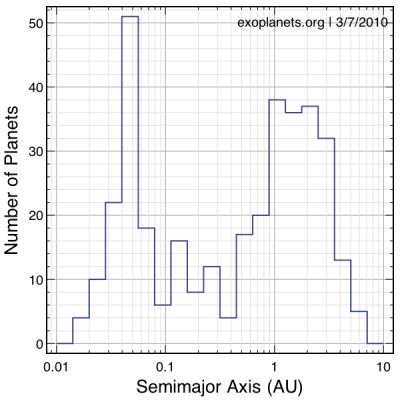
- Many systems have Jupiter-size planets closer to their star than in our Solar System
- Two Possibilities:
- Formation: there is a way of forming gas giants close to stars
- Migration: Planets move during/after the formation process
- Enhanced by selection effects
- Solar Systems like ours are still hard to find
Migration and Other Ideas
- Migration:
- Jovian planets form far from the star
- Spiral inwards due to drag from the primordial stellar nebula
- Migration stops at the inner edge of the disk
- Could be more likely in very heavy stellar nebulae
- Formation:
- Close Jupiters just formed differently than in our Solar System
- Might be very different from Jupiter in detail?
Distribution of Orbital Eccentricities
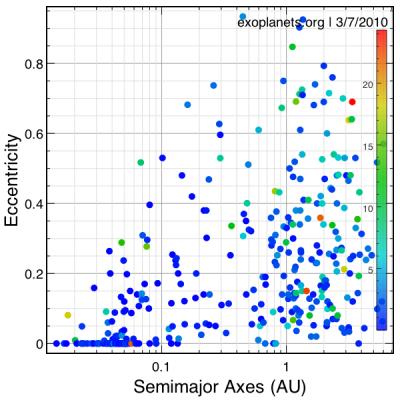
Very elliptical orbits are interesting
- Solar System
- Jovian and Terrestrial orbits are nearly circular
- Objects with very elliptical orbits (comets, scattered KBOs) had those orbits perturbed by gravitational interactions
- Among Extrasolar Planets:
- Very elliptical orbits are common
- A few show strong resonances
- Implies strong gravitational perturbations
- Lends support to the migration idea
Planet Frequency
- Planets are found in about 8% of the stars in the solar neighborhood so far
- Selection effects: systems more like our solar system are harder to find, could still be common
- Basic patterns are emerging:
- Don't often find planets around low-mass stars (stars smaller than the Sun)
- Don't find planets around metal-poor stars
Low-mass Stars
- Planets would be easiest to find around low-mass stars
- Smaller stars would have a bigger orbital reflex motion
- We don't find many planets around stars much less massive than the Sun
- Even though low-mass stars are very common!
- May not be that surprising:
- Small stars have small proto-stellar disks
- Not enough raw materials to make big planets
Metallicity and Extrasolar Planets
- Astronomers call all heavy elements "metals" (heavier than H and He)
- Metallicity measures their abundance
- High-metallicity = lots of rock, ice for planets
- The Sun is metal-rich for stars of its age
- Stars with planets have unusually high metallicity even relative to the Sun
- Could mean that unusual planets are caused by unusually high metallicity?
Is Solar System Different?
- Systems with high metallicity have more ice and rock to form giant planets
- Did they initially form more gas giants?
- Did gravitational interactions among them re-arrange the orbits to what we see now?
- Did the Sun have a smaller than usual proto-stellar disk?
- Don't form as many gas giants?
- Don't have strong migration due to the disk?
See A Note about Graphics to learn
why some of the graphics shown in the lectures are not reproduced with
these notes.
[
Return to the Astronomy 161 Main Page
|
Unit 7 Page
]
Updated: 2010 February 16
Copyright © Paul Martini All Rights
Reserved.