

|
Astronomy 161
Introduction to Solar System Astronomy
Prof. Paul Martini
|
Lecture 44: Life in the Universe
Key Ideas:
- Life:
- Extreme Life on Earth
- Requirements for Life
- Are We Alone?
- Life vs. Intelligent Life
- Drake Equation
- Extraterrestrial Civilizations?
- Prospects for Contact
Extreme Life on Earth
- Dark Life: Bacteria thrive many kilometers beneath the Earth
- Hot Life: Microbes survive in boiling geyser pools and deep under the ocean by thermal vents
- On the Moon: Strep bacteria may have survived 3 years on the lunar surface (this is somewhat controversial)
Requirements for Life
- Energy
- Warmth to produce liquid water (liquid methane?)
- Energy to fuel chemical reactions
- Complex chemistry
- Elements heavier than H and He
- Building blocks for complex molecules
- Protection from harmful UV
- Too fast mutations may inhibit the development of complex life
- Ozone layer, underwater, or underground
Life in the Solar System?
- Mars
- May have had liquid water and a thicker atmosphere in the past
- Europa
- Liquid water ocean warmed by Jupiter's tides
- Protected by an outer shell of ice
- Titan
- Methane chemistry
- Complex molecules are present
Each may meet the three requirements for life to develop
Life in the Galaxy? The Universe?
- Our Milky Way galaxy is VERY BIG and VERY OLD
- Over 100 billion stars
- 10% or more may have planetary systems
- Over 10 billion years old (twice the age of our Solar System)
- And our Milky Way is just one of billions of galaxies in the Universe
Even if the probability that life would form is incredibly small, there nevertheless must be billions of planets out there...
Life vs. Intelligent Life
- Life formed within a billion years on the Earth, yet intelligent life required 4.5 billion years
- There may be additional requirements for intelligent life
- Long-lived, stable star (>4.5 Gyr)
- Chemically rich
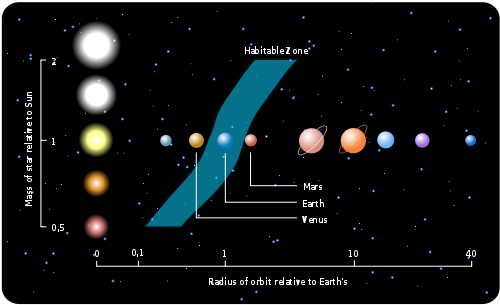
- Just the right distance from the central star (the "habitable zone")
The Drake Equation
N = R* fp ne fl fi fc L
- N: number of advanced civilization in the Galaxy
- R*: rate at which Sun-like stars form
- fp: fraction of stars with planetary systems
- ne: number of Earth-like planets per system
- fl: fraction of Earth-like planets with life
- fi: fraction where intelligent life has evolved
- fc: fraction with communication technology
- L: lifetime of an advanced civilization
Measurement and Conjecture
- Only the first 3 terms of the Drake Equation can be measured by astronomers:
- R* ~ 1 per year (Sun-like stars)
- fp ~ 0.1 to 0.2 from recent planet searches
- ne: the number of Earth-like planets per system may be measureable in the next 20 years
- The rest are pure conjecture
What constitutes an advanced civilization?
- This usually means:
- Capable of communicating across interstellar distances.
- Capable of interstellar travel by spacecraft
- Interested in finding and communicating with other civilizations
- Are we "advanced?" Maybe...
- Radio technology for ~100 years
- Manned spaceflight for ~40 years
- May be able to detect other signals
Anyone Else Out There?
- One very optimistic view:
- ne = 0.1 (1 in 10 solar systems have Earths)
- fl = 1 (if Earth-like, life is inevitable)
- fi = 1 (if life, intelligence is inevitable)
- fc = 1 (if intelligence, technology is inevitable)
- L = 100 years (for us, so far so good)
- N = 1 x 0.1 x 0.1 x 1 x 1 x 1 x 100 = 1!
- And if civilizations last 1000 years, there would be 10
Extraterrestrial Visitations? No.
- "Extraordinary claims require extraordinary proof"
- No extraordinary proof has been offered:
- Fuzzy photographs
- Anecdotal accounts of visits and abductions
- Claims of government conspiracies
- There are unexplained sightings, but failure to explain them does not justify a leap to a truly wild explanation
Where are they?
- The extreme difficulty of interstellar travel is a plausible explanation of a lack of visits
- The distances between stars are enormous
- Need very large amounts of time or
- Extremely large amounts of energy
- The fastest spacecraft: Voyager 1 and 2
- Outward bound at 15 km/s (0.005% the speed of light)
- Need 80,000 years to reach the nearest stars
How to make Contact?
- Direct visits are difficult
- At 0.1c it still takes 50 years to reach the NEAREST star
- Energy costs are enormous:
- Maybe possible if sufficiently advanced
- Communication is cheap
- Messages travel at the speed of light
- Very low energy cost per message
- But what wavelength would you use?
- How would you translate the message?
The Search...
- SETI: Search for Extraterrestrial Intelligence
- A relatively inexpensive search strategy to look for radio signals from etraterrestrial civilizations
- Phoenix Project of the SETI Institute
- Optical and Microwave SETI at Harvard
- Various smaller projects
What are we looking for?
- Signals that appear "artificial"
- Very narrow "bandwidth" (<300 Hz, the narrowest natural maser sources)
- Pulsed signals (common way to encode information)
- Highly polarized signals (another encoding scheme)
- Very little frequency "drift"
- So far, no detections...
Life, the Universe, and Everything
- Our ability to predict the probability of life in the Universe is limited by the fact that we only have experience with one planet
- Definitive identification (or not) of life in any form elsewhere in the Solar System would prove extraordinarily valuable
- If intelligent life does exist elsewhere, communication seems much more likely (cheaper) than direct visitation
See A Note about Graphics to learn
why some of the graphics shown in the lectures are not reproduced with
these notes.
[
Return to the Astronomy 161 Main Page
|
Unit 7 Page
]
Updated: 2010 March 7
Copyright © Paul Martini All Rights
Reserved.